

Credit: Nuno Guitars
Built, Not Borrowed: The Nuno Guitars Team Sits Down with Gil Soucy on the International Effort Behind the Colt and Acoustic Series
On July 5, 2025, Nuno Bettencourt walked onto the stage at Back to the Beginning — Black Sabbath's farewell concert — carrying a guitar nobody had ever seen. It had the silhouette players had studied for three decades. But it had stripes, and the headstock didn't say Washburn. It said Nuno.
The internet did what the internet does. Within hours, forums were dissecting frame grabs. Was it a one-off? A prank? A new company?
It was a new company. But it wasn't new. By the time that guitar hit the stage, it had already lived a long, quiet life — as sketches, as conversations, as a series of concept instruments taking shape in master builder Chris Meade's Cincinnati workshop, where Nuno's ideas were being explored one handcrafted prototype at a time. What the audience saw that night was a preview of a project still deep in development.
The part of the story that came next is the part almost nobody has heard.
Because once Nuno and Chris had proven what these guitars could be, a different question took over: how do you take a handful of handcrafted concepts and turn them into a family of production instruments — including a line of imported guitars that had to carry the same DNA at a fraction of the price? That question consumed the better part of two years, spanned multiple countries and time zones, and pulled in engineers, luthiers, wood specialists, CNC programmers, and factory teams on more than one continent.
The Thoroughbred Series master-builts and the U.S.-made Stable Series have received most of the early attention, and deservedly so. But the imported Colt Series and the Lusitano acoustics may represent the most complicated engineering effort of the entire launch — and the least understood.
We sat down with Gil Soucy to talk about what it actually takes to build an instrument that most players will simply pick up, play, and — hopefully — fall in love with. When it comes to building great guitars, few have Gil’s depth of experience. With more than four decades in the musical instrument industry, he has held senior leadership roles spanning manufacturing, product development, international sourcing, and distribution, helping build and scale a portfolio of global instrument brands. As President and Chief Development Officer of Stone & Gold, Soucy brings rare fluency in both the craft of guitar building and the global infrastructure required to deliver instruments at scale—a combination that has helped steer Stone & Gold's partnership with Nuno Bettencourt and made the company the connective tissue behind the development of Nuno Guitars.
Nuno Guitars: Let's start at the beginning. Where did this project actually begin for you?
Gil Soucy: Well, the honest answer is that it began long before us. Before Stone & Gold was involved at all, Nuno had been working with Chris Meade — who's built his guitars for years — turning sketches and ideas into real, playable concept instruments. That exploratory phase is where the identity of these guitars was born. The guitar Nuno played at Back to the Beginning came out of that work.
Our chapter starts when the conversation shifted from what could this become? to how do we bring this to the world? Once the creative direction was proven, somebody had to build the machinery around it — the engineering, the manufacturing relationships, the supply chain, the quality systems. That's where we came in.
Nuno Guitars: People sometimes ask: who designed these guitars?
GS: And the honest answer is that there wasn't one designer. There was an artist with a very clear vision. There was an extraordinary master builder helping shape those ideas into physical form. There were experienced engineers figuring out how to manufacture them. There were world-class international builders bringing them to life at scale. And there were a lot of people making sure everyone stayed aligned. That's how products like this actually get built. Anyone who tells you otherwise is selling a story.

Nuno Guitars: Nuno could have done what most artists do — license his name to an existing platform and approve some finishes. Why wasn't that enough?
GS: Because that was never the objective. Nuno wasn't looking to put his name on someone else's guitar. He wanted to build his own brand — instruments that reflect the way he thinks about guitars, top to bottom. And the moment that became the goal, everything changed. We weren't selecting from existing designs or off-the-shelf platforms. We were building a product family from the ground up.
I want to be clear about what that means practically, because it's the single biggest thing separating this project from a typical signature line. In a licensing deal, the hard decisions are already made — the platform exists, the tooling exists, the factory already knows how to build the guitar. Here, none of that existed. Every model, every series, every price point had to be engineered on purpose.
Nuno on Why He Didn't License
After hearing Gil describe the early days, we asked Nuno why he took the hard road:
“Because the easy road ends with a guitar I wouldn't play. I've been handed plenty of 'here's your model, pick a color' opportunities over the years. That's not a guitar company — that's a sticker. If my name is on the headstock, it has to inspire somebody the way my original guitars inspired me. There was no shortcut to that.”
Nuno Bettencourt
The Import Question
Nuno Guitars: Most players assume an imported guitar is just a simplified copy of the American one. Cheaper wood, cheaper parts, same drawings. True?
GS: That's probably the biggest misconception surrounding this entire project. An imported instrument isn't “the American one built somewhere else.” It's an entirely new engineering exercise.
Think about what actually changes when you move a design across the world. Different lumber supply. Different humidity. Different finishing systems. Different machining equipment, different tooling, different tolerances, different processes that a factory has spent decades perfecting — for their products, not yours. Every one of those variables affects how a guitar feels and sounds. So, if your goal is to make something that feels exactly like another instrument, you're often starting from scratch. There were very few moments during this project where we could simply copy something.

Nuno Guitars: And I imagine that misconception cuts the other way, too — people assume “import” means a lesser factory.
GS: That's the part I push back on hardest. World-class manufacturing exists all over the world. Full stop. The builders we partnered with on the Colt Series are extraordinary — the kind of operation that can hold tolerances and consistency at a scale a custom shop could never touch. That's its own form of mastery.
Our challenge was never finding capable builders. Our challenge was translation: taking a highly personal, handcrafted concept and turning it into a repeatable production process without losing its soul. Building one exceptional guitar and building the five-thousandth exceptional guitar are completely different engineering problems. Chris solves the first one brilliantly. Our international partners solve the second. The project needed both.
Recreating a Legend: The Colt N4
Nuno Guitars: Was there one challenge on the import side that stood above the others?
GS: The Colt N4. Without question.
Everyone knows the N4. Players have stared at photographs of that guitar for over thirty years. They know it from across a room. They know how it's supposed to feel even if they've never held one. That creates a genuinely dangerous situation, because if you're even slightly wrong, they'll know. Instantly.
Nuno Guitars: How do you revisit and reimagine a classic when the dimensions are known?
GS: Dimensions are easy. Character is hard.
There's a personality to that instrument — the neck carve, the balance, the way the body sits against you, the visual proportions, the transitions between surfaces. Almost none of that shows up on a blueprint. And you have to remember, we weren't trying to satisfy a spec sheet. We were trying to satisfy the one person on Earth who has lived with that guitar for decades. Nuno notices things in milliseconds that most people would never consciously identify.
We'd hand him a prototype and he'd say something like, “The shoulder feels a little too full,” or “the neck wants to rotate differently in my hand,” or — my favorite — “this doesn't disappear the same way.” Those aren't measurements. They're instincts. And then our engineering team's job was to reverse-engineer why he felt that way and fix it. That loop — prototype, play, reject, diagnose, revise — ran more times than I'd like to admit.
Nuno Guitars: So, he was deeply involved. This wasn't approving photos over email.
GS: Not even close. He played prototypes. He rejected prototypes. He compared them against his personal guitars — the actual instruments, side by side. He'd send us back to engineering right when we thought we were finished. And honestly? That was exactly what you want from an artist. He never once accepted “good enough.”
One detail I'll point out because players will care: the Colt models carry the same five-bolt Extended Cutaway neck joint that's defined Nuno's guitars for decades. That joint is not trivial to produce consistently at this price point. It would have been far easier to quietly substitute a conventional heel and hope nobody noticed. Nobody in the building ever suggested it.
Nuno on the Colt N4
We read Gil's comments back to Nuno and asked what he was listening for in those prototype sessions:
“People think I was checking specs. I wasn't. I'd close my eyes and play, and I was waiting for the moment I forgot which guitar was in my hands. The first prototypes — I always knew. And then one day I picked one up, played for a while, and realized I hadn't thought about it once. That's when I knew we had it. With the stuff coming from overseas, everybody assumes 'beginner guitar.' No. We went and found the best of the best — builders who can fool you into asking, wait, this was made where?”
Nuno Bettencourt

The Stripes: Dark Horse and White Stallion
Nuno Guitars: The Colt Dark Horse and White Stallion have those signature wood stripes running across the body. Most people probably assume that's a finish treatment.
GS: And most people would be wrong! Those stripes are actual contrasting wood — real laminations set into the body, not paint, not veneer graphics. The design traces back to a B.C. Rich Mockingbird that Nuno's older brother, Luís, owned when they were kids. It's a deeply personal visual signature, which meant faking it was never on the table.
Here's what that means from an engineering standpoint. Different wood species expand and contract at different rates. Every glue line behaves differently under finish. Every machining pass has to anticipate that movement, or you end up with stripes that telegraph through the finish, or shift visually, or worse, compromise stability. Getting through-body laminations right on the master-builts is hard. Getting them right in production, guitar after guitar, with visual consistency and long-term stability, at an accessible price — that took an enormous amount of engineering on both sides of the ocean. Through-body laminations have been common for years on many brands… BUT they have mostly been with the wood grain all going in the same direction. Stripes in a “cross grain” pattern that are through-body have a different challenge for getting them right.
And the irony is that it's a detail most players will never consciously think about. Which usually means you've done your job.
From Workshop to Production
Nuno Guitars: At what point did you know these concepts were actually becoming real products?
GS: When the domestic production engineering came together — and that's where Matt Larrivée became instrumental. Chris had done an incredible job helping Nuno explore the creative direction and prove out the designs. Matt helped bridge the gap between those original handcrafted concepts and instruments that could be built consistently in a production environment. Those are two very different disciplines, and the project needed both done at the highest level.
Everyone brought a different expertise to the table. That's genuinely what made this work. And I'll say — Chris and Matt each have their own stories to tell about this project, and those stories deserve more than a paragraph from me. Players will be hearing from both of them directly.

An Acoustic That Had No Business Being This Complicated
Nuno Guitars: Outside of Extreme's massive hit "More Than Words," Nuno isn't typically associated with acoustic guitars, so the Lusitano caught a lot of people by surprise. It may also be the most ambitious design in the entire launch. Fair?
GS: Very fair. And it was an entirely different engineering universe.
Here's the thing about electric guitars: they're precise. You can isolate variables. An acoustic is alive — everything affects everything else. Move one brace and the top behaves differently. Change the top thickness and the voice changes. Alter the bridge weight and the response changes. There is no such thing as an isolated decision inside an acoustic guitar.
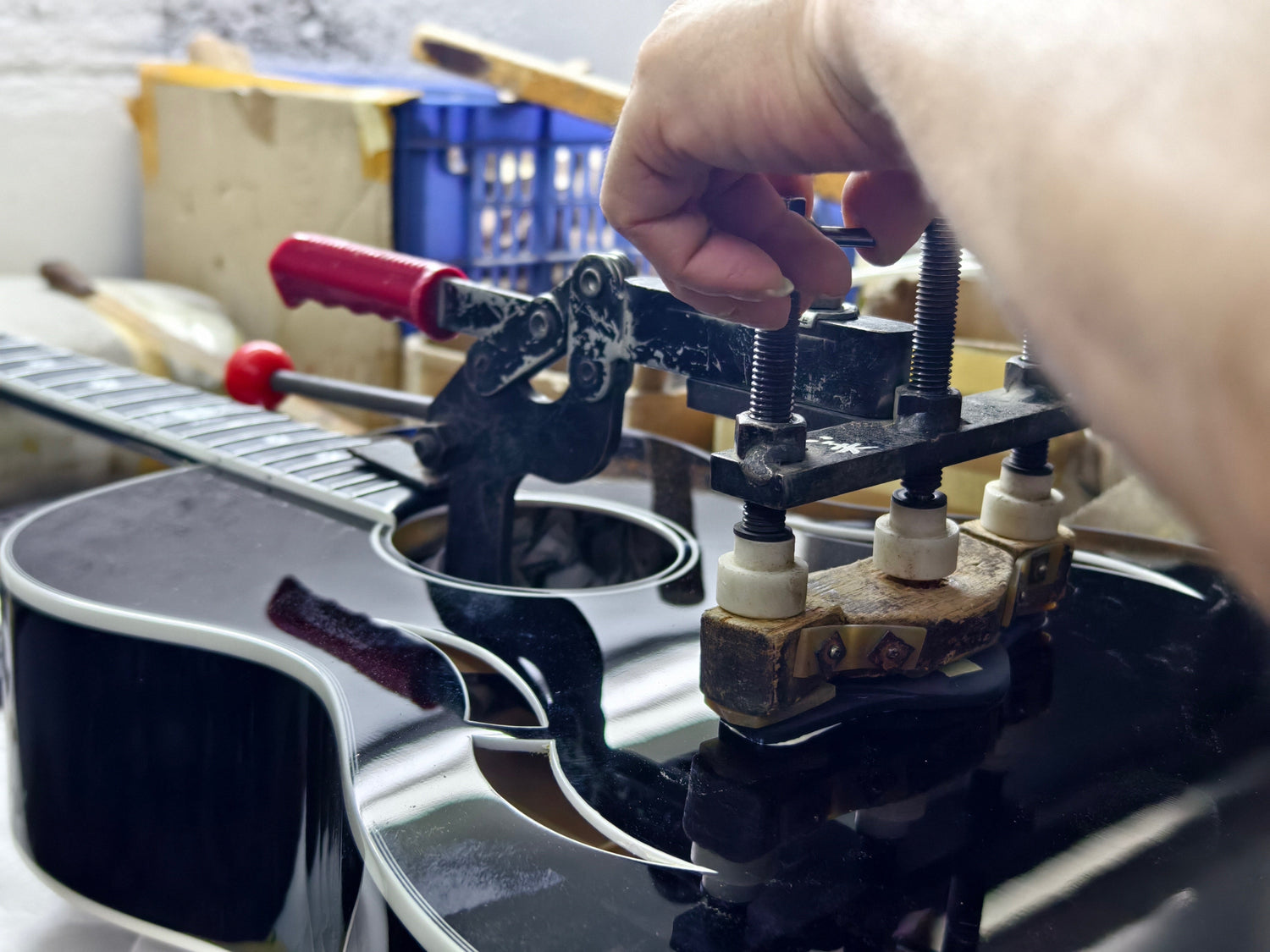
Now add the fact that the Lusitano doesn't borrow an existing platform. Look at the top: you've got the traditional round soundhole flanked by two custom f-holes that trace the shape of the Grand Auditorium body. That's not decoration. Every opening you cut in a soundboard removes structure and changes how the top vibrates. A conventional bracing pattern is designed around one round hole in one place. The moment you add those f-holes, the standard playbook is gone.
Nuno Guitars: So, the bracing had to be redesigned from scratch.
GS: Completely customized. Our acoustic partners — and this is a workshop that genuinely specializes in resonance and voicing, true acoustic people — had to develop a bracing layout specific to this top: something that restored the structural integrity around those f-holes while preserving the response Nuno wanted. Clear articulation, warm low end, balanced projection, and critically, a top that will stay stable under string tension for decades. That became one of the deepest engineering conversations of the entire program. There were versions of that layout that measured fine and just didn't sing. You keep going until it sings. Our acoustic design partner has a 20+ year history of tweaking bracing, wood thicknesses and finishes to create the best acoustic tone available. He is also one of the most prominent wood suppliers worldwide for guitars, so the Lusitano AAS is built with some of the best solid woods available anywhere.

Nuno Guitars: And the details on that guitar are unusually elaborate for its price point.
GS: By design. The headstock had to become part of the brand's visual identity — it carries a custom recessed Nuno logo, which is a more expensive way to do it and absolutely the right way to do it. And at the 12th fret, a Lusitano’s head inlay, painstakingly designed by Nuno and our team. Nuno made the decision to move to the horse inlay after an earlier model featured a different motif, as this closer ties to the brand’s overall theme. That's Nuno's heritage set into the fingerboard. Gloss black body, white binding all the way around, solid spruce top, solid mahogany back and sides. And a neck that — in Nuno's words — plays more like an electric, because he's always wondered why acoustics shouldn't. For variation, we created the brother to the Lusitano AAS - the “Lusitano ASL”, which features select laminated wood on the top, back and sides. Similar with a slight tonal variation.
At every decision point on that guitar, the question was “how do we build the guitar this design deserves?” Sometimes that meant inventing solutions instead of borrowing them.
Nuno on the Lusitano
“The Lusitano is probably the most 'me' guitar in the whole line, and it doesn't even have a Floyd on it. It's named for the Portuguese horse. The cross inlays, the emblem at the twelfth fret — that's where I come from, in an instrument. And I told the team: I don't want a copy of anybody's acoustic. I've played beautiful acoustics my whole life that fight you. I wanted one that plays like it already knows the song. What they had to engineer to get there — I'm not sure people will ever fully appreciate it. Honestly, I hope they don't have to.”
Nuno Bettencourt
The Money Question
Nuno Guitars: Let's talk about cost, because these guitars land at aggressive prices. Was cost a constant presence in these conversations?
GS: Of course. It has to be — pretending otherwise would be dishonest. But I think people misunderstand what value engineering means when it's done right.
Value engineering shouldn't mean making something cheaper. It should mean making every dollar work harder. If refining one component saves five dollars, and you can reinvest those five dollars somewhere a player will actually hear or feel the difference — the neck, the fretwork, the setup, the pickups — that's smart engineering. That's completely different from cutting corners and hoping nobody notices.
The uncomfortable truth of this industry is that nobody notices good decisions and everybody notices bad ones. So, the discipline was: spend where hands and ears live, save where they don't, and never touch the things that make it a Nuno guitar.
Nuno Guitars: And what does your role actually look like in all of this? “Project management” seems like an understatement.
GS: It sounds almost too simple, doesn't it? My responsibility was making sure dozens of moving pieces stayed pointed at one vision. When you have an artist, a master builder, production engineers, international factories, prototype schedules, logistics, and commercial deadlines all moving simultaneously, somebody has to keep everyone rowing in the same direction. Stone & Gold became that connective tissue.
Some days that meant solving technical problems. Some days it meant translating an artist's instinct into engineering language — turning “it doesn't disappear in my hands” into something a factory can act on. Some days it meant helping a manufacturing team understand why one seemingly tiny detail mattered enormously. There were a lot of late-night video calls, because someone was always waking up while someone else was going to bed. But it was never about one person making decisions. It was about helping extraordinarily talented people solve problems together.
Nuno Guitars: What surprised you most across the whole program?
GS: How emotionally invested everyone became. Engineers, factory managers, finish specialists, wood experts, CNC programmers, supply chain people — across multiple continents — everyone wanted these guitars to succeed. We'd spend hours on details most customers will never consciously notice. But those invisible details add up. That's what quality actually is: thousands of small decisions, made by people who care, over a very long time.
Nuno Guitars: Why do you think customers don't appreciate how much work goes into instruments like these?
GS: Because they shouldn't have to. If we've done our jobs, a player picks one up and says, “this feels great.” They're not thinking about wood movement or tooling limitations or how many prototypes came before that one. They're making music. Ironically, the better the engineering, the more invisible it becomes.

Looking Back
Nuno Guitars: When you look at the finished Colt and Acoustic lines now, what are you proudest of?
GS: That we didn't compromise the mission. The easiest thing in the world would have been to release “good enough” — nobody outside the building would have known the difference on day one. But Nuno would have known. We kept pushing instead, even though it took a little longer than we had planned.
The Colt N4 doesn't pretend to be inspired by an N4. It strives to deliver the experience players have associated with that guitar for thirty years. The Lusitano doesn't feel like a brand extension somebody bolted on — it feels like it was always supposed to exist. Those were brutally difficult goals. They were also the only goals worth pursuing.
Nuno Guitars: Last question. A player walks into a room, picks up a Colt or a Lusitano for the first time. What do you hope happens?
GS: I hope they don't think about engineering. I hope they don't think about manufacturing, or how many countries were involved, or anything you and I have talked about today. I hope they pick it up, play one chord, smile — and forget entirely that they're holding an imported guitar.
Because that was the objective from day one. If we've succeeded, none of the thousands of engineering decisions matter anymore. Only the music does.
To everyone who has followed this project since a mystery guitar appeared on stage at Back to the Beginning — thank you. We know the wait was longer than anyone expected. Every extra month was another opportunity to make these instruments better, and we believe you'll feel that time the moment you pick one up.
Check out the Colt Series and Lusitano acoustics.

For more than four decades, Gil Soucy has been behind the scenes bringing guitars from concept to player. Today, he serves as President and Chief Development Officer of Stone & Gold.


